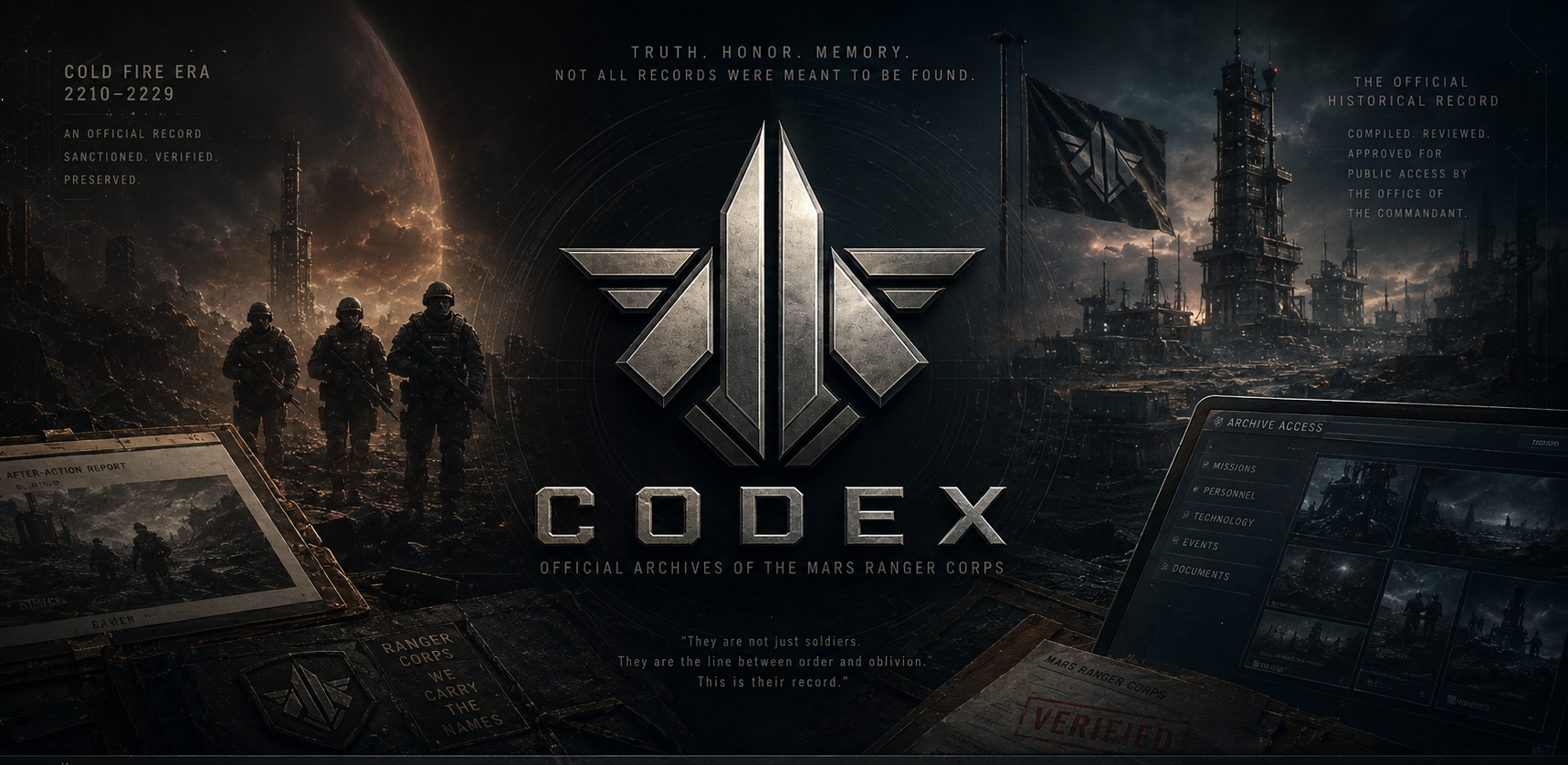
The CODEX is the most complete surviving historical archive of the Mars Ranger Corps and the period commonly designated the Cold Fire Era. It contains the command-approved record, restricted testimony, recovered operational material, private correspondence, telemetry, archival fragments, and later authenticated evidence gathered into a single evidentiary record. No one source is treated as sufficient by itself.
The CODEX is not one version of history. It is the place where every surviving version is preserved together.
I have spent the better part of my life inside these records — not as a reader, but as an excavator. Official reports. Ranger testimony. Command traffic. Personal correspondence. Maintenance logs. Combat telemetry. Sealed proceedings. Private journals. Fragments recovered decades after the people who created them were gone. Each tells the truth differently. None tells all of it.
That is the reason this archive exists.
The official record tells us what the Corps was prepared to certify. Other records preserve what individual Rangers, civilians, officers, engineers, families, and witnesses experienced beyond that account. Neither layer becomes false merely because the other exists. The mistake comes when one surviving record is allowed to become the whole memory of what happened.
My work has therefore not been to replace one history with another. It has been to gather them. What follows is not a correction of the official record. It is the record made whole.
Some entries confirm one another. Some contradict. Some explain decisions that appeared senseless when viewed only from the field. Others expose the distance between what a command believed, what a soldier saw, and what later evidence eventually proved. Where that distance remains unresolved, I have left it unresolved. An archivist should preserve uncertainty with the same care he preserves certainty.
I should also say plainly that I am not a neutral party. No honest archivist is. These events are old history to most people — the names are carved into monuments, the battles are taught in schools, and outcomes that once depended upon frightened, exhausted people making impossible decisions are now described as though they were inevitable. I do not find them inevitable.
I find people.
Some failed. Some lied. Some misunderstood what was happening around them. Some obeyed orders they regretted for the rest of their lives. Some stood between danger and another human being when there was every reason not to. The documents preserved here belong to all of them.
What I ask of you is simple: read the whole record. Read what the Corps certified. Read what the Rangers remembered. Read what the machines recorded. Read what families kept. Read what later investigators found. Hold the accounts beside one another long enough for the shape between them to become visible.
The men and women in these pages did not think they were making history. They thought they were trying to survive it. That distinction matters more than I can say.
Authenticated command-approved records, public reports, official histories, unit documentation, and other material accepted into the formal historical record.
Authenticated testimony, restricted accounts, suppressed or sealed records, and other evidence preserving events or perspectives the public record did not fully contain.
Letters, journals, telemetry, field notes, private communications, technical records, physical artifacts, and later evidence recovered outside the original historical compilation.
Provenance notes, cross-references, contradictions, contextual analysis, unresolved questions, and conclusions identified by Jonah R. Grand during reconstruction of the complete archive.
Jonah R. Grand
Archivist — MRC Historical Division
Records within the CODEX retain their original classification, provenance, and evidentiary status wherever known. Contradictory accounts are preserved rather than reconciled without sufficient evidence.
We carry the names. The least we can do is carry them accurately.
I am often asked where to begin. People come to this archive looking for a specific name, a specific engagement, a specific answer. What most discover is that no record exists by itself. Saturn makes more sense beside the years that preceded it. The Corps makes more sense beside the institutions that created it. Even a personnel file changes when you know what pressures shaped the person inside it. So I offer the same orientation I give everyone who enters the CODEX for the first time.
Humanity spread across the solar system through the twenty-first
and early twenty-second centuries unevenly, following resources,
industry, research, and survival more often than any coherent
civil plan. Mars. Ceres and the Belt. The Jovian system. Saturn.
Distance changed more than transportation. It changed the practical
relationship between people and the institutions claiming authority
over them.
Governments could legislate across the system. They could not
always govern it at the speed events required.
Infrastructure increasingly became power.
No private institution exploited that reality more effectively
than Colossa Corporation. Its influence did not
begin with armies or declarations of authority. It grew through
contracts, manufacturing capacity, research partnerships, technical
infrastructure, logistics, and relationships with governments that
increasingly depended upon systems Colossa could build faster than
they could.
The public record describes that relationship as partnership.
Other records preserved here show something more complicated.
Neither description is sufficient by itself.
In 2195, the United Earth Defense Council authorized creation of
the Mars Ranger Corps as a special-operations
branch within the United Earth Navy. Its public mission was clear:
provide a rapid-response force capable of operating where ordinary
military, law-enforcement, and emergency structures could not —
Belt piracy, colonial unrest, industrial catastrophe, and threats
emerging too far from established authority for conventional
response.
Colossa Corporation was publicly credited as instrumental in the
Corps’ creation, providing funding, technical infrastructure,
training facilities, weapons development, and tactical doctrine.
That account is authentic.
It is also incomplete.
The CODEX preserves the founding charter alongside records showing
who shaped the institution behind it, what different architects
believed they were building, and how the Corps eventually became
something none of them could entirely control.
The Rangers who would later become central to the Cold Fire Era
did not arrive at Saturn unformed. They had already been shaped by
years of violence, extraction missions, frontier deployments,
corporate pressure, political instability, and assignments in places
where the formal chain of command often ended before the danger did.
Block 17. Vale Station. Red Dunes. Ganymede. Ceres. Operations
recorded publicly and operations that were not.
Some of those events produced doctrine. Some produced scars.
Some produced relationships that would matter more than either.
The CODEX preserves those histories because Saturn did not create
the people who fought there.
It revealed them.
In 2210, Saturn Early Warning Station was lost.
The official record describes a catastrophic engagement at
humanity’s outermost watchpost, the destruction of the station,
and the survival of three Rangers:
Torch. Grim. Stone.
Survivor testimony preserves what those Rangers experienced inside
the station. Telemetry preserves things none of them could have seen.
Later evidence raises questions that neither record could answer at
the time.
The CODEX keeps all of it.
Not because one account must defeat the others, but because the
event becomes visible only when the surviving records are allowed
to stand beside one another.
History provides the context. The records provide the evidence. What follows is preserved according to its original provenance: what entered the official history, and what survived beyond it.
Access the Records
The CODEX preserves material according to its original provenance and evidentiary status. Sacred Canon records what entered the command-approved historical record. Shadow Canon preserves authenticated material that existed outside, beneath, or beyond that public account. Both belong to the same archive.
Sacred
Canon
Enter the official record
Orders. After-action reports. Personnel records. Public histories. Command findings. The authenticated account the Mars Ranger Corps and its governing institutions were prepared to place into the historical record.
Enter Sacred Canon →CODEX INDEX · SACRED CANON

Shadow
Canon
Enter the concealed record
Survivor testimony. Restricted reports. Recovered transmissions. Sealed proceedings. Field accounts and authenticated evidence that preserve events, experiences, or context the public record did not fully contain.
Enter Shadow Canon →CODEX INDEX · SHADOW CANON
Archivist’s note: classification identifies where a record came from and how it entered the historical archive. It does not determine whether the people inside it understood the whole event.