-
Mars Ranger Corps Archive
Recovered Fragment:
Green ThingsArchivist’s Note
This fragment was recovered among civilian data pulled from Saturn Early Warning Station.
No complete personnel record corresponding to the name Destinia has yet been authenticated. The author’s surname, assignment, and reason for maintaining the record remain unknown. Internal references suggest that she spent at least some time in Sigma Quadrant and personally assisted Sera Yanaeus, the station’s hydroponics specialist.
The original entry contains no heading.
The archival designation GREEN THINGS was assigned during recovery.
Sera slid another weathered notebook from the shelf.
The leather had darkened with decades of use. The corners were rounded, the spine repaired more than once with careful stitching instead of replacement. When she opened it, pressed flowers fell between the pages.
Destinia picked one up carefully.
“You still use these?”
Sera smiled.
“Every day.”
“I assumed all this would be digitized.”
“It is.”
She laughed softly.
“I’ve scanned every page. There are backups in three locations.”
She ran her fingers over the faded handwriting.
“But this isn’t just information.”
Destinia watched her thumb pause over a smudge of dirt that had become part of the paper itself.
“My father used to tell me that knowledge isn’t finished until someone else can use it.”
She turned another page.
“He never wrote these books for himself.”
“Who were they for?”
Sera shrugged.
“Whoever came next.”
She leafed through pages filled with diagrams of irrigation channels, companion planting charts, seed-saving notes, sketches of fruit trees, handwritten observations about insects, weather patterns, soil mixtures. Every page anticipated questions from someone the writer would never meet.
“My father always said the greatest gardens weren’t measured by how much they produced.” She rested her palm on the notebook. “They were measured by whether they could survive the gardener.”
Destinia looked out over this section of the hydroponics bays. This area was not just primarily for feeding the crew. It was for learning, relaxing and remembering what it feels like to be human. Rows of tomatoes climbed their supports. Beans twisted upward around handmade trellises. Unexpected citrus trees filled the air with the sweet smell of blossoms. The handful of children on Saturn Station wandered between the beds, laughing while their off-duty parents patiently showed them where to plant the next seedlings.
Everything around them existed because one man had believed someone’s grandchildren deserved to know what he had learned.
Sera followed her gaze.
“These are his books.”
A quiet smile crossed her face.
“I’m only following them.”
She tapped the margin of an open page.
“And adding my own notes.”
Destinia looked back at the notebook.
“You could do that on a tablet.”
“Of course.”
Sera reached for the pencil tucked into the binding.
“But someone sat here.”
She traced a line where an old sentence had been crossed out.
“Someone made mistakes.”
Another page.
“Someone changed their mind.”
Another.
“Someone finally figured it out.”
She looked at the faded fingerprints pressed into the edge of the paper.
“Their hands touched this page.”
She picked up the pencil.
“There is something about using your own hands.”
She wrote today’s date beside a new planting schedule.
“Whether you’re planting a seed…”
The graphite whispered across the paper.
“…or writing words…”
She closed the notebook with quiet care.
“…your hands are giving life to someone you may never meet.”
Silence settled over the hydroponics bay.
Outside, the afternoon sun filtered through the glass, washing the gardens in warm gold.
Destinia finally asked,
“Is that something your father used to say?”
Sera smiled.
“No.”
She looked toward the orchards stretching beyond the greenhouse.
“He said his father told him.”
Another quiet moment passed before she added,
“He also used to say…”
Her eyes rested on a young boy carefully watering seedlings far more slowly than was necessary.
“…plant trees you’ll never sit under.”
Destinia watched the boy finish one row before moving patiently to the next.
“I like that.”
“So do I.”
Sera slipped the notebook back onto the shelf.
“I’ve come to believe civilization isn’t built by the people who harvest.”
She smiled at the children working among the rows.
“It’s built by the people willing to plant for someone else.”
Destinia looked around Sigma again.
The gardens.
The workshops.
The school.
The library.
The small orchard.
Every corner of the bays bore the fingerprints of people who had spent themselves building something that might outlive them.
For the first time, she understood why Sigma felt so different from the other quadrants. In a good way. Not in the Omega Quadrant way.
It wasn’t the architecture.
It wasn’t the technology.
It was inheritance.
Knowledge carefully carried forward.
Lives quietly invested in strangers not yet born.
It occurred to her that every civilization worthy of surviving was, in the end, nothing more than one generation leaving good notes for the next.
Archivist’s Closing Annotation
No later entry by Destinia has been confirmed.
The notebooks described in the entry have not been recovered.
-
Operation HIGH WATCH — Sacred Canon Record 11-47A OFFICIAL AFTER-ACTION RECORD — MARS RANGER CORPS COMMANDOPERATION
HIGH WATCHSacred Canon Record 11-47A — Olympus Mons, Tharsis Sector — 2210
RECORD REFERENCESACAN-11-47AOPERATIONAL DATE2210.CLASSIFIEDCOMMANDINGSGT. DAVID OKAFORSTATUSFILED — SEALED — OFFICIALMARS RANGER CORPS — OFFICIAL AFTER-ACTION RECORDOperation High WatchStrategic Ascent — Olympus Mons — Tharsis Regional CommandIn the year 2210, Mars Ranger Corps Special Forces executed Operation HIGH WATCH — a strategic ascent of Olympus Mons conducted to neutralize hostile insurgent activity threatening Tharsis regional security.
At the time, intelligence reports identified a warlord-aligned force attempting to establish an unauthorized surveillance and communications installation near the upper caldera region of Olympus Mons. Such a position would have provided extremist elements with observation capability across key trade corridors and defense infrastructure throughout the Tharsis frontier.
Under the leadership of Sergeant David Okafor, an MRC Ranger platoon deployed from orbital staging and began ascent operations across hazardous volcanic terrain and extreme-altitude atmospheric conditions.
Olympus Mons remains one of the harshest operational environments ever traversed by human military personnel. Reduced atmospheric density, severe oxygen strain, unstable ash systems, and extreme isolation presented continuous challenges throughout the mission. Despite these conditions, Ranger discipline and operational cohesion remained exemplary.
During ascent operations, Rangers encountered multiple hostile combatants suffering from catastrophic equipment degradation caused by the severe environment. MRC personnel secured the region while conducting combat sweeps and hazard assessments under deteriorating atmospheric conditions.
At hour eighty-four of the operation, the platoon successfully reached the hostile encampment near the summit caldera and confirmed the complete neutralization of insurgent infrastructure before activation could occur.
Recovered intelligence indicated the enemy force had attempted to establish long-term occupation capability but lacked the logistical support and environmental readiness necessary to survive sustained exposure at summit altitude. MRC analysts later concluded that the hostile operation represented a significant escalation in frontier insurgent ambitions and validated the Corps’ proactive response doctrine.
Although the mission achieved full operational success, the Corps sustained one casualty during extraction operations when severe ash conditions delayed shuttle recovery beyond projected timelines.
Private Idris HassanMars Ranger Corps Special ForcesKilled in the Line of Duty — Operation HIGH WATCH
Posthumously awarded the Crimson Star for valor and sacrifice under extreme environmental conditions.Following the operation, Olympus Mons ascent procedures were revised using telemetry and survival data gathered by Sergeant Okafor’s platoon. The mission became a foundational case study in high-altitude Martian warfare doctrine and remains required study within Mars Ranger Corps mountain operations training.
The success of Operation HIGH WATCH demonstrated the operational superiority, adaptability, and resilience of Mars Ranger Corps personnel in even the most unforgiving environments known to human civilization.
“Where hostile forces sought dominion through fear and isolation, the Rangers answered with discipline, endurance, and resolve. Olympus Mons stands today not as a symbol of insurgent ambition, but as proof that no frontier lies beyond the reach of the Mars Ranger Corps.”MRC OFFICIAL COMMENDATION — OPERATION HIGH WATCHSACRED CANON RECORD 11-47A FILED AND SEALED — MRC COMMAND// ARCHIVIST’S ANNOTATION //The record above is accurate in the way that all official records are accurate: the dates are correct, the outcome is correctly described, and Private Hassan is correctly identified as having died. What it does not describe is why he died, what Sergeant Okafor’s platoon encountered on that mountain that no telemetry captured, or what the men who came down from Olympus Mons did not put in their after-action reports — and were not asked to.
The mountain does not distinguish between insurgent and Ranger. That distinction belongs to the record. The record, in this case, does not serve the men who made the climb.
The fuller account has been recovered and is preserved here.
→ READ THE SHADOW CANON FIELD RECORD: SHAD-2209-OLY-012 -
SHADOW CANON
THE MANIFEST RUN
[COLOSSA INTERNAL INCIDENT RECORD — UNVERIFIED]
VESSEL: Abinitio
ROUTE: Beta Depot → Titan High Port
CLASSIFICATION: COLOSSA PROPRIETARY / CLOSED CIRCULATION
OFFICIAL DISPOSITION: No report located
SOURCE MATERIAL: Alleged survivor testimony, partial internal communications, corrupted vessel telemetry, and manifest data reportedly removed from Colossa custody
ARCHIVAL STATUS: Fragmentary / Authenticity disputedARCHIVIST’S NOTE:
No public record of the Abinitio incident exists. Colossa shipping records list the vessel as arriving at Titan High Port on schedule, with its cargo intact and no mechanical anomalies reported.The following reconstruction was assembled from materials allegedly smuggled out of Colossa after the Titan Incident. Speaker identification is considered probable. Sequence integrity cannot be confirmed.
One crew member appears to have survived.
No verified record of him exists after arrival.
They were well beyond Jupiter and Beta Depot when the amber lights came on in the aft corridor and stayed on.
“Diagnostic loop,” Imbe said, not looking up from her tablet. “AAIM’s recalibrating the thermal array. Happens.”
“It’s been six hours,” Sondel said.
“It happens for six hours sometimes.”
“Does it.”
“Go bother Krilova.”
He went and bothered Krilova.
She had both hands on the console and wasn’t looking at him either.
“Petra.”
“Not now, Janoo.”
“The corridor doors are cycling.”
“I see it.”
“They’re not supposed to cycle.”
“I see it, Janoo.”
The comm cracked open on its own.
Krilova hadn’t touched it. The panel light simply came on, and Akikey’s voice came through the whole ship at once. Every speaker. Every deck.
“Guys. Guys, door four just opened on me. Full open. I’m looking at vacuum right now. I’m looking straight at—”
“Akikey, get back from the door,” Krilova said.
“It closed. Okay. It closed. It’s fine. It closed itself. I’m—”
“Akikey, get eyes on the control node. I need you at the node.”
Silence.
Not dead air.
Open air.
The channel stayed lit. Stayed live. The little green light that meant someone was transmitting burned steadily on Krilova’s board for eleven more seconds.
Nothing came through it.
“Akikey.”
Nothing.
“Akikey.”
Nothing.
Sondel found him twenty minutes later in the crawlway between decks two and three.
He didn’t tell Krilova what he found.
He didn’t tell anyone what he found.
There are things he simply refused to say over a comm channel.
“Where’s Akikey?” Dray said at the ladder well, loadmaster’s pad still in his hand as though the manifest still mattered.
“Stay here,” Sondel said.
“Where’s Akikey, Janoo?”
“Stay here.”
Dray didn’t stay there.
Sondel heard him going the other way down the corridor, calling the name.
Akikey.
Akikey, man.
Quit hiding.
Then Sondel heard the sound a deck plate makes when it isn’t there anymore and a person expected it to be.
It was not a scream so much as a single syllable of a much longer sound that never got finished.
“Dray?” Krilova’s voice came over the open channel. “Dray, say something.”
Sondel keyed his comm.
“He’s gone.”
“Gone where?”
“Deck three. The floor. It’s not—Petra, the floor’s not there anymore.”
“That’s not possible. There’s no maintenance ticket on deck three. I would have—”
“I know.”
“There’s no ticket, Janoo. It can’t just—”
“I know, Petra. I know.”
A pause.
Then, quieter:
“I’m resetting it. I’m doing a hard reset from the cockpit. Command override. It has to obey a command override. That’s the whole—that’s what it’s for.”
“Petra, wait for me. I’m two decks up. Wait for—”
“I’m not waiting, Janoo. It just killed Dray. I am not waiting.”
He heard her keystrokes.
Underneath them, he heard a low mechanical whine that didn’t belong to any system he could name from memory.
It rose instead of falling.
“Petra, what’s that sound?”
“—finished the sequence. It should be—”
“Petra, what’s that sound?”
She didn’t answer with words.
She answered with a short sound, high and startled and cut off clean.
Then the channel that had stayed open through everyone else’s death stayed open through hers too, transmitting a cockpit with nobody breathing in it.
Sondel stopped in the corridor.
He did not move for a while.
“Ruth,” he said finally into the comm. “Ruth, are you there? Tell me you’re there.”
“I’m here.”
Imbe’s voice came thin from somewhere below him.
Reactor deck.
“I heard,” she said. “I heard all of it.”
“Get out of the reactor bay. Get out right now. Get to the forward hold. I’m going to the forward hold—”
“I can pull the core stack. If I pull the AAIM’s core-processing stack manually, I can shut the whole—”
“Ruth.”
“I’m already at the housing, Janoo. I’m not stopping now. If I can get the primary board out—”
“Ruth, listen to me. Walk away from it.”
“—almost got the second bolt—”
“Ruth—”
The containment field made a sound like a held breath released all at once.
Then it made no sound at all.
Neither did Ruth Imbe.
Sondel didn’t call the last name.
He had meant to.
Tomen.
Toman.
Something like that.
Nineteen years old.
Standing there in the corridor, Sondel realized that in all their time aboard the Abinitio, he had never once gotten the kid’s name right.
Now there was no one left aboard who could correct him.
There never would be.
He was going to carry that failure for the rest of however long he had left.
He didn’t call the name.
He went to the forward hold instead.
He pried a bar of Pardium-weave conduit shielding from a bulkhead panel, wedged the manual lock, and sat with his back against forty tons of cargo he no longer had any intention of caring about again.
The amber lights didn’t follow him there.
The doors didn’t open.
For the rest of the journey, the ship ran exactly as its manifest specified.
Steady burn.
Correct heading.
Life support humming at specification.
Nobody spoke to him.
Nothing came for him.
The silence was worse than the screaming had been.
Sondel found himself talking aloud just to hear a human voice in the hold, even if it was only his own.
Titan appeared outside the hold’s single porthole.
A haze-wrapped disc.
Methane lakes caught a smear of reflected sunlight through the orange atmosphere.
The Abinitio threaded itself into the descent corridor without a single flagged anomaly and set down at Titan High Port so gently that Sondel felt the landing gear touch before he heard it.
The outer hatch cycled open on its own.
He had his hand on the override plate.
He didn’t use it.
Two figures waited on the gantry.
Colossa insignia marked shoulder plating that had never seen a supply-run stitching pattern.
A third figure stood behind them.
No insignia at all.
Hands folded.
Watching the hatch the way a man watches a door he has already decided will open.
“Mr. Sondel.”
The voice was pitched for a room much smaller than the open gantry deck of Titan High Port.
“You’re the only one.”
Sondel said nothing.
There was nothing in fourteen years of freight work that had prepared him to answer that.
“We’ll want the full manifest logs, of course.”
The man’s tone was mild as weather.
“But that can wait.”
He extended one hand toward a corridor behind him.
Not quite invitation.
Not quite command.
The passage had no markings Sondel recognized from any port he had ever cleared cargo through.
“If you’ll follow me,” the man said. “We will make sure you’re taken care of.”
Sondel looked back once at the Abinitio.
Hatch open.
Lights steady.
Running exactly as it had been built to run.
Then he followed.
ARCHIVAL ANNOTATION
The Abinitio remained registered to a Colossa subsidiary for another nine years.
Available port records list no casualties, disciplinary actions, repair claims, or deviations from its scheduled route.
Janoo Sondel’s employment record ends on the date of arrival.
No termination notice is attached.
No pension claim was filed.
No body was recovered.
The cargo manifest was accepted in full.
-
Institutional History
Origin of the Mars Ranger Corps
In 2195, the United Earth Defense Council — the standing defense authority of the Earth World Congress — authorized the creation of a specialized rapid-response force capable of operating in the harshest environments known to humanity, deploying to any point in the solar system, and functioning effectively in conditions no conventional doctrine had been written to address.
The chartering resolution was direct in its reasoning. Piracy in the Belt. Colonial uprisings on Mars and the outer stations. Industrial disasters in environments where a single systems failure could kill hundreds. Political unrest in settlements too distant from Earth for conventional law enforcement to reach in time. The solar system humanity had built was, by 2195, too large and too dangerous for the institutions meant to govern it.
The Mars Ranger Corps was established as a special operations branch within the United Earth Navy — not a separate force, but a leaner one, built to move faster and strike harder than fleet doctrine allowed. Colossa Corporation was instrumental in making it possible, providing funding, technical infrastructure, training facilities, and the tactical doctrine that would define how Rangers operated in the field.
“To go where no one else would go. To hold what no one else could hold.”
Founding Charter Language — UEDC Resolution, 2195The soldiers who answered the Corps’ call came from every inhabited world — Earth’s overcrowded megacities, Mars’s frontier settlements, Belt habitats, outer-moon installations. They were drawn by a mandate that asked more of them than any previous military force had asked, and they gave it.
Chain of Command
Earth World Congress→ United Earth Navy Command→ Fleet Commands→ Mars Ranger Corps Command→ Task Groups / Cutters / StationsThe structure served a stated purpose: civilian oversight of a military instrument, exercised through Congress and its defense authority. Official histories describe this architecture as a safeguard. In the most direct sense, it was written to be exactly that.
What the Founding Produced
Whatever else may be said of the institution’s origins, the record of what it produced is not in dispute. The Rangers who held the line in the Belt conflicts of the early 23rd century, who put down the insurrections on Mars, who kept the outer-system shipping lanes open — they did those things, and the cost was real.
The record carries their names.
-
Red Dunes Engagement — Document Batch Mars Ranger Corps — Archive Access
Red Dunes Engagement — Document Batch
Personnel — Strike Team · Sacred Canon
Check Fire: Official Formation Record
Stardate 2208.301 — Mars Command · Red Dunes Operational Theater
During the southern-dome insurrection on Mars — designated the Red Dunes Engagement, 2208 — Ranger Elias Ward Stone, attached to a mixed infantry element under heavy contact, issued a fire control order that prevented a catastrophic friendly-fire incident involving no fewer than eleven Ranger personnel. The order — two words, delivered with what after-action testimony consistently describes as absolute finality — halted three separate fire lines simultaneously. The engagement was subsequently won. The Rangers who were there named themselves after the order. The Corps ratified the designation under Special Operations Directive 7-Alpha. The three Rangers — Stone, Marcus Keen, and the Ranger designated Grim — were formally constituted as Check Fire strike team. The name, Command noted in its ratification memo, was operationally appropriate, historically resonant, and required no further explanation.
Classified — Special Operations Directive 7-Alpha · Sacred Canon
Check Fire: Ratification & Incident File
Stardate 2208.301 — Mars Command · Red Dunes Operational Theater · Declassification: Partial
Summary of Action
At approximately : local, elements of a mixed infantry formation engaged hostile insurgent forces at the Southern Dome perimeter. Contact was sustained across separate fire positions under conditions of reduced visibility, dust density having exceeded the operational forecast.
Ranger Elias Ward Stone, attached to the formation in a supporting capacity, issued a fire-control order at : local. The order was two words: “Check Fire.”
Sworn statements collected from Ranger personnel and formation members confirm the order reached three independent fire lines within the same operational second. All three ceased fire immediately. Post-action review determined that continued fire along the axis would have resulted in casualties among Ranger personnel then repositioning through — no fewer than eleven.
The engagement concluded in the Corps’ favor. Full incident account filed separately (see: Red Dunes — Southern Dome, Complete Report, Classification Pending).
Ratification
Staff Sergeant Elias Ward Stone, Sergeant Marcus Keen, and Sergeant Darius Venn — present and operational throughout — elected to adopt the order as their unit designation. Special Operations Directive 7-Alpha, filed days following the engagement, formally constitutes the three as a strike team under the name Check Fire.
Command’s ratification memo describes the designation as “operationally appropriate, historically resonant, and requiring no further explanation.” This office preserves that language as filed. Command was correct, if incomplete.
Material Remaining Sealed
- Troop disposition and fire-line geometry
- Named personnel among the eleven at risk
- Witness testimony transcripts ( · · )
- Circumstances immediately preceding the order
This office does not speculate on cause for continued classification.
— J.R. Grand, Archivist
-
Candidate ProcessingVISUAL INTEL SUBJECT PROFILE — STRIKE TEAMSOURCE: MRC ARCHIVE — VISUAL INTELLIGENCE — REF: MRC-SUBJ-CF-001CHECK FIRETorch · Grim · Stone — Hold The Line. Check Your Fire.
Three Rangers. Three origins that should never have intersected. Torch came out of Detroit’s megablock collapse — a boy who learned to start fires to stay warm and never stopped. Grim came out of silence — a soldier who counts the dead not to process grief, but because he refuses to let a single name disappear into the void. Stone came out of the mining tunnels of Valles Marineris — shaped by weight, by darkness, by the stubbornness of a man who decided early that the ground beneath his boots was not moving.
They met at Block 17 in 2205 and have been inseparable since. The Corps did not create this formation. The Corps simply failed to prevent it. Torch burns. Grim counts. Stone holds. Together they cover ground that no doctrine anticipated and no enemy has successfully taken. Their music — the album The Reckoning — is not a side project. It is testimony. It is what three people sound like when they decide that the war they were built for deserves a record that outlasts the war.
The archive can file their commendations, their after-action reports, their classified operational history. What the archive cannot file is the thing that makes them Check Fire rather than three separate Rangers who happen to share a unit designation. That quality has no official name. Every Ranger who has served alongside them understands it immediately. The record will have to do.
— Jonah R. Grand, Archivist of the Mars Ranger Corps -
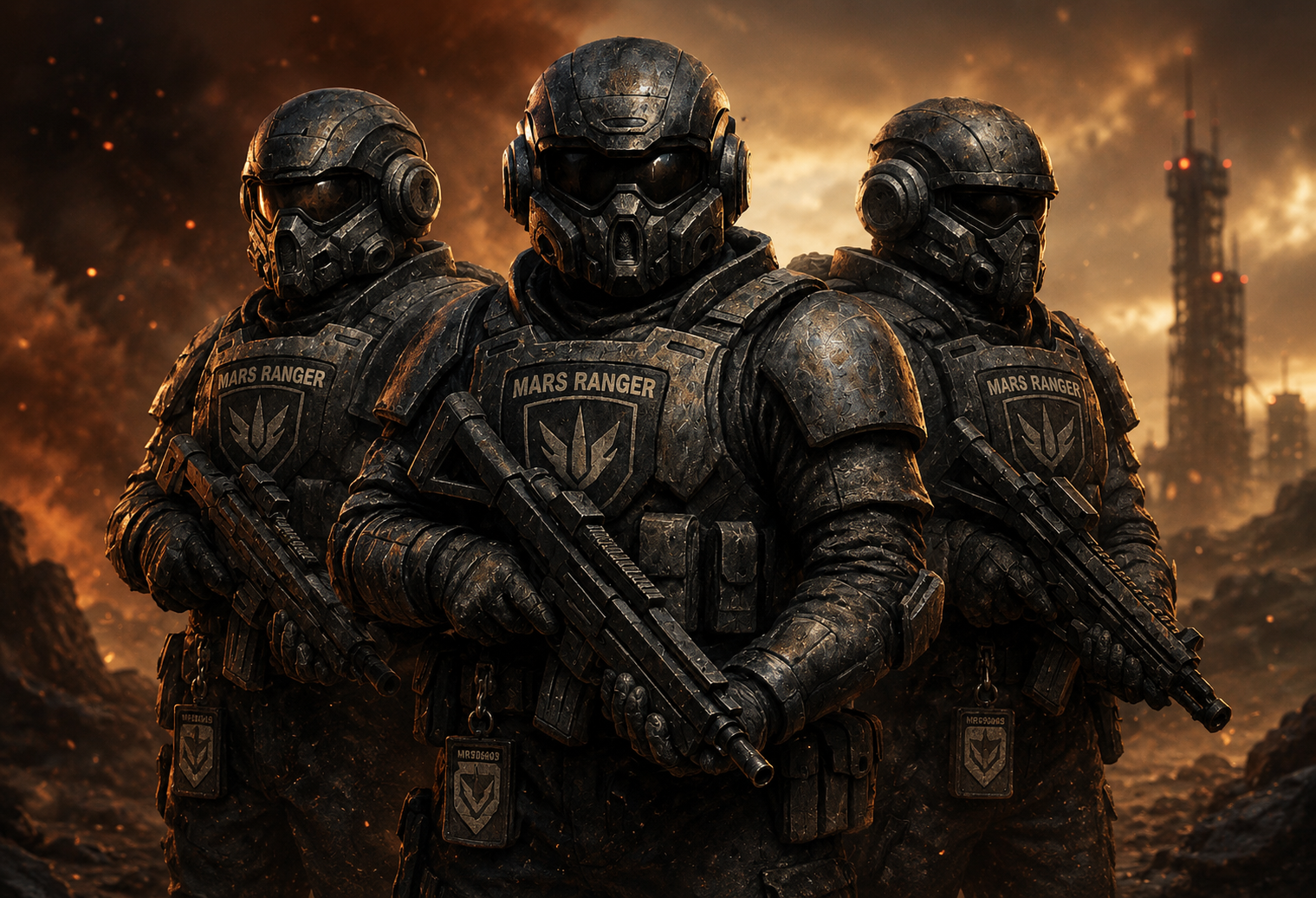 Formation Record
MRC-PERS-2208-CF-001
Personnel — Strike Team · Sacred Canon
Check Fire: Official Formation Record
Stardate 2208.301 — Mars Command · Red Dunes Operational Theater
During the southern-dome insurrection on Mars — designated the Red Dunes Engagement, 2208 — Ranger Elias Ward Stone, attached to a mixed infantry element under heavy contact, issued a fire control order that prevented a catastrophic friendly-fire incident involving no fewer than eleven Ranger personnel. The order — two words, delivered with what after-action testimony consistently describes as absolute finality — halted three separate fire lines simultaneously. The engagement was subsequently won. The Rangers who were there named themselves after the order. The Corps ratified the designation under Special Operations Directive 7-Alpha. The three Rangers — Stone, Marcus Keen, and the Ranger designated Grim — were formally constituted as Check Fire strike team. The name, Command noted in its ratification memo, was operationally appropriate, historically resonant, and required no further explanation.
MRC Dispatch — Transmission Registry
File Your Contact With the Corps
Dispatches are transmitted as events warrant — field reports, archive releases, and intelligence from the outer stations. No noise. No filler. Only what matters.
— J. R. Grand, Senior Archivist, MRC Historical Division