
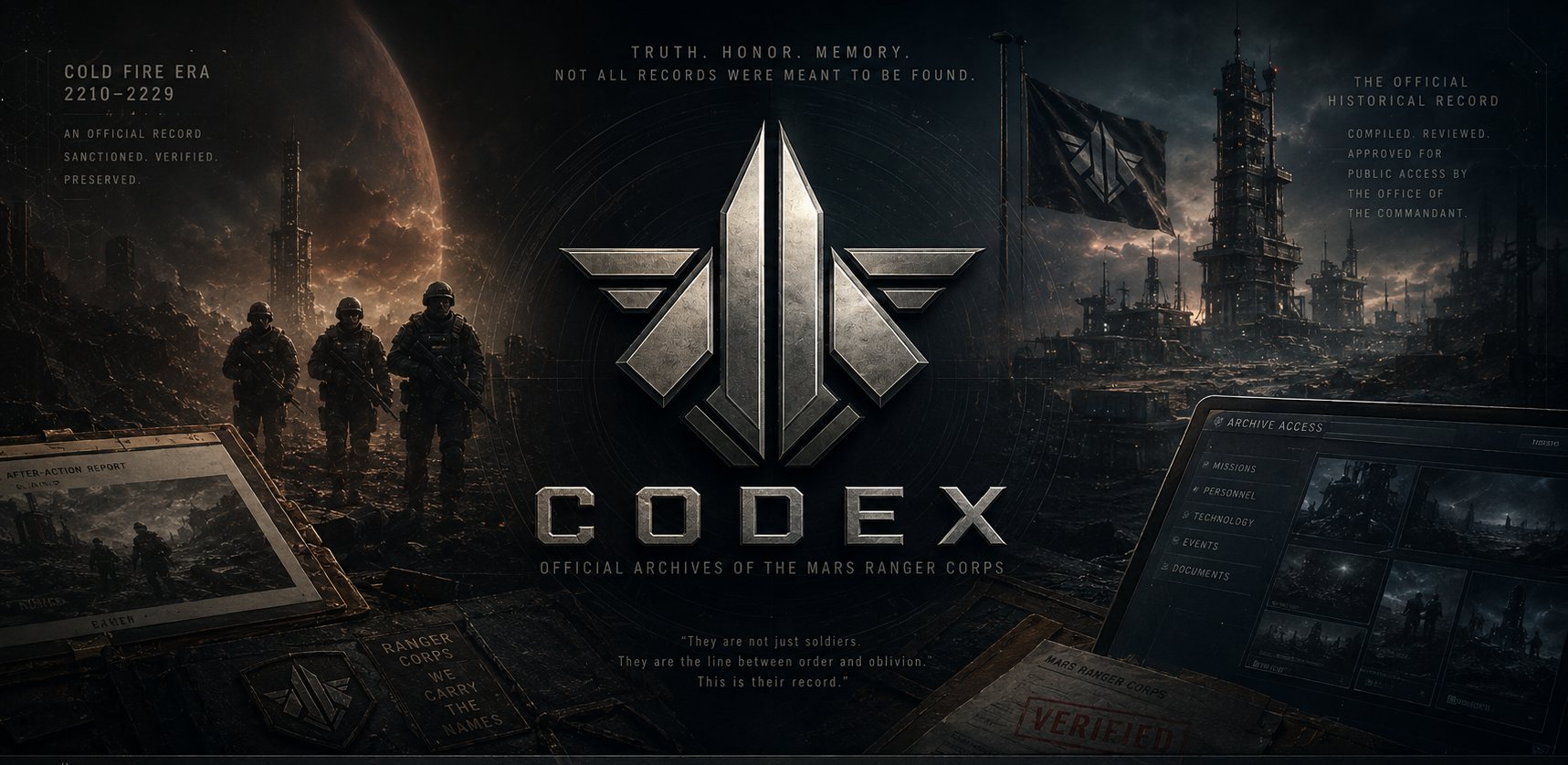
The CODEX constitutes the official historical record of the Mars Ranger Corps and its associated operations during the period commonly designated the Cold Fire Era. Compiled from sanctioned unit reports, command communications, and verified testimony, this archive represents the Corps’ authoritative account of the conflicts, personnel, and events that defined the expansion period. All materials have been reviewed and approved for public access by the Office of the Commandant.
What you have just read is what was approved. What follows is what happened.
I have spent the better part of my life inside these records — not as a reader, but as an excavator. The CODEX as the Corps released it is not a lie, precisely. It is something more insidious than a lie. It is a careful arrangement of true things, ordered to obscure what the true things mean. Battles are documented. Casualties are numbered. Commendations are issued. And the architecture of why any of it occurred remains buried beneath the weight of official language and redacted pages.
My work has been to find what was buried. Letters that were never transmitted. After-action reports filed and then quietly removed from the public index. Testimony given in closed proceedings and sealed for reasons that no longer serve anyone living. What I have recovered, I have added here — not to contradict the official record, but to complete it. I have marked my additions clearly. The reader may judge what was omitted and why.
I should say plainly that I am not a neutral party. No honest archivist is. These events are old history to most people — the names are carved into monuments, the battles are taught in schools, the outcomes are treated as inevitable. I do not find them inevitable. I find them extraordinary, and I find the people who shaped them more extraordinary still. Some of them I feel I have come to know across the distance of years in a way I cannot fully explain. That is the strange gift of this work, and its particular burden.
What I ask of you is only this: read both layers. Read what the Corps said, and read what the Corps did not say. Hold them together. The distance between those two things is not merely historical. It is, I believe, the distance between what we tell ourselves we are and what we actually are — as institutions, as soldiers, and as people trying to hold something together in the dark.
The men and women in these pages did not think they were making history. They thought they were trying to survive it. That distinction matters more than I can say.
Jonah R. Grand
Archivist — MRC Historical Division
The annotations contained herein represent independent research and do not reflect the official position of the Mars Ranger Corps or its successor institutions. All recovered materials are presented in their original form where possible.
We carry the names. The least we can do is carry them accurately.
I am often asked where to begin. People come to this archive looking for a specific name, a specific engagement, a specific answer. What most of them discover is that the answer requires more context than they arrived with. So I offer the same orientation I give everyone who finds this archive for the first time.
Humanity spread across the solar system in the early 22nd century — not in an orderly progression, but in the way of all resource extraction: wherever the material was, people followed. Mars. The Belt. The Jovian stations. The outer colonies at Saturn. Governments moved slowly. Capital moved faster. By mid-century, the distance between official authority and actual power had become a geography of its own.
One entity came to occupy more of that gap than any other. Colossa Corporation did not seize control of the outer system through force — not initially. It did so through contracts, through research partnerships, through the quiet placement of personnel in positions that did not, on paper, constitute authority. By the time the scope of that influence was visible, it had been structural for decades.
The Mars Ranger Corps was established in 2195 as a special operations force within the United Earth Navy — humanity’s frontier shield, by the official account. It attracted the best soldiers the system had to produce. It deployed them to postings that were difficult, dangerous, and, this archive has established, not always chosen for the reasons those soldiers were given. The full history of the Corps’ founding is held in restricted files. I will say only this: the record of who wrote the original doctrine is not what the public record claims.
Between 2205 and 2210, a generation of Rangers was shaped by a series of engagements across the system — urban conflicts, frontier skirmishes, postings at the edges of charted space where dimensional anomalies had begun appearing with a frequency the official science liaison office was consistently slow to report. The Rangers who survived those years were, without exception, changed by them. This archive holds the records of what those deployments actually were, and what they were preparing those soldiers for.
In 2210, at Saturn Early Warning Station, 507 Rangers died in three days.
The official account describes an overwhelming alien incursion, a catastrophic
dimensional breach, and a station that held as long as it could. Three Rangers
survived. The Corps made them legends.
This archive’s account of Saturn is longer, and different, and not yet fully
declassified. What I can tell you is that the official record of that engagement
has more silences in it than any document of its kind should have.
The rest is in the files. That is why the files exist.
The Mars Ranger Corps Universe
A 24-book military science fiction universe spanning three interconnected series. Each series stands alone. Together they tell one story from three angles — with every reveal engineered around the order you read them.
The three seriesThe Cold Fire Saga
The main series. The war from the front line. Start here.
The Iron Widow Saga
A parallel war fought entirely in shadow. Read after Book 2.
Forge of War Prequels
The generation before Saturn. How the soldiers were made.
Where to go from here
The reading order tells you which book to start with and why the sequence matters. The archive is here when you’re ready to go deeper.